This article was updated on 03/10/19. Happy Daylight Savings Day!
There are many accessories that you can buy for your table saw to make it more versatile, safe, powerful, accurate, and convenient. One such accessory is the table saw extension, or outfeed table.
What this accomplishes is, as you might guess from the name, extends the working real estate of your saw. Specifically, it extends the square footage on the table surface allowing you to work with larger pieces of stock. When is this helpful?
Especially when crosscutting lumber or sawing sheets of plywood or similar material.
Store-Bought or Home-made Table Saw Extension?
There are many commercial table saw extensions available on the market today. Some of these are made for specific models from their manufacturers, while others try to satisfy the configurations of many different makes and models.
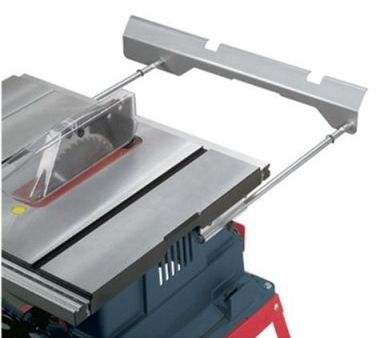
There are expensive ones and cheap ones. Most of us prefer ones that are high-quality, no frills, and affordable like the Rockler table saw outfeed table pictured on the left.
On the other hand there is the type of wood worker who delights in not only designing but building all his own woodworking jigs for his wood shop. Building an extension for his table saw is just one more challenge to be savored.
A quick search via the internet will locate many, many personal pages where these craftsmen (and craftswomen) display their home made extensions complete with high resolution pictures and step by step instructions.
Requirements for Table Saw Extensions
As with all power tools in your wood shop, the number one concern is safety. All design and usage considerations must be made with safety at the forefront. But aside from that, there are several other requirements. Let’s look at a few of them.
Configuration. The extension must be configured so that it mates up with well, and securely attaches to, your particular table saw.
In addition, a good table saw extension is designed to install and uninstall quickly so you can get about your business and not spend all your time on set-up and tear-down.
Minimum vibration. It’s important to keep all vibration to a minimum to make sure that you get the most accurate cut possible, especially when doing finish work.
This is one of the marks of a pro. Also, any mistakes on a project will compound as it proceeds to completion. Start off clean and keep it that way.
Level as she goes. The extension should be level with the surface of your table saw in order to get an accurate cut, with respect to the degree of the angle of the cut. Also, if there are any level deviations between your table saw and its extension, there will be a tendency for you blade to bind.
The consequences of this might be safety issues, burn marks on your wood, and shortened blade life. Before making the first cut, check this with either a 4' level or a laser level
Diversity. Not strictly a requirement, but the more you can diversify your tools and equipment, the more productive and less cluttered your wood shop will be. This is especially important in smaller shops where space comes at a premium. For example, my shop is a two-car garage. Not exactly an abundance of real estate.
As an example of tool diversity, one common adaptation is to make your extension double as a router table. Another situation is when your wood shop only has room for a benchtop table saw.
An Alternative
There is one alternative that can offer a degree of versatility although it requires some careful set up. You can buy rollers on stands that have a height adjustment.
There are many situations where this is all you need and they can be much faster than setting up your extension. An added bonus is that they are easy to stow away when not in use.
Have you got any tips or tricks with table saw extensions or outfeed tables in your shop? Share them with our readers in the comment section below. If you found this article helpful, please pass on the link to your friends and social media. We’re all in this together!
Did you find this article helpful? Thanks for supporting this free site with a small donation! We rely on our readers rather than a paywall.
About the Author:
Kelly R. Smith was a commercial carpenter for 20 years before returning to night school at the University of Houston where he earned a Bachelor’s Degree in Computer Science. After working at NASA for a few years, he went on to develop software for the transportation and financial and energy trading industries. He has been writing, in one capacity or another, since he could hold a pencil. As a freelance writer now, he specializes in producing articles and blog content for a variety of clients. His personal blog is at I Can Fix Up My Home Blog where he muses on many different topics.













 Kelly R. Smith was a commercial carpenter for 20 years before returning to night school at the University of Houston where he earned a Bachelor’s Degree in Computer Science. After working at NASA for a few years, he went on to develop software for the transportation and financial and energy trading industries. He has been writing, in one capacity or another, since he could hold a pencil. As a freelance writer now, he specializes in producing articles and blog content for a variety of clients. His personal blog is at