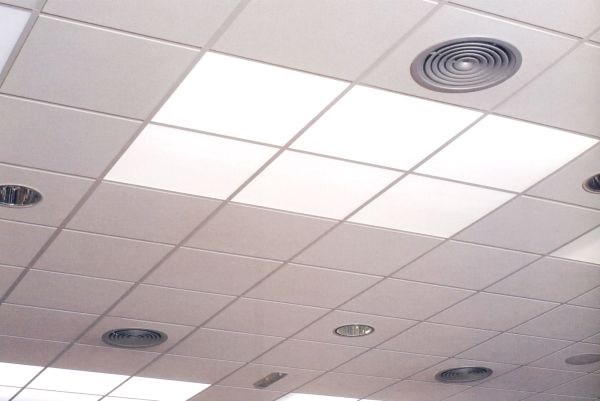
A 2' X 2' suspended acoustical ceiling with recessed lights
This article was last revised on 11/05/20.
This article is a step by step guide to laying out and installing a suspended acoustical grid ceiling. It explains nailing up the wall angle (molding), installing hanger wires and the grid, leveling the grid, and installing the ceiling tiles. I realize that there is a lot of detail here, but I was a ceiling mechanic (installer) for over 20 years and I want you to get this DIY project right the first time.
Always check your local building code before embarking on a remodeling project. For example, the state of California has specific rules in the code regarding hanger wire placement because of earthquakes. Who knew?
Why Install an Acoustical Ceiling?
Why indeed? A suspended grid ceiling, otherwise known as an acoustical ceiling, can be a great improvement in some areas of your home. For example, if you’re remodeling your basement or turning it into a game room or a man cave with a tiki bar, a grid ceiling is easy to install and allows you to take advantage of can lights or florescent light fixtures that sit right in the grid.
If you’d rather not DIY but would rather hire a pro, be sure to vet your contractor. This installation really is a specialty task.
Let’s take a look at the tools and material needed to complete this project. Most big box stores (Home Depot, Lowes) carry what you need or can get it for you.
Laser level or water level (a link to instructions on how to make one is at the bottom of this article)
Acoustical ceiling grid (12’ main runners, 4’ T’s, 2’ T’s optional).
Brand names include Donn and Armstrong.
Wall angle (molding)
Ceiling tile (2' X 2' or 2' X 4')
12 ga. hanger wire
Nails
Fence staples
Nail up the Wall Angle
Determine the desired finish height of your new ceiling and make a pencil mark one inch (the height of the wall angle) above that on the wall. Allow at least 4 inches below the ceiling joists or any obstructions to allow working space to later fit in the tiles. Be sure you have that spacing everywhere or you will have to build soffits and that's a whole different ball game.
You’ll need more clearance for light fixtures, ect. In fact, if you are going to use drop-in fixtures rather than surface-mount, go to the store and size them before starting your project.
You will have to allow more clearance than just the thickness of the fixture because to install them you will have to angle them up to get them into the grid.
You’ll want the ceiling to be level. You can use a laser level in a room with straight walls, but when the space has a lot of corners or halls, I like to use a water level to transfer benchmarks.
I find it easier to mark the benchmarks at eye level at inside and outside wall corners and then and then measure up to strike the chalk lines. So, remember the mark you make in the first step? Make a mark under it at eye level. Measure the difference between the two marks. Now make a "story pole." This is just a length of dowel or anything convenient with a bottom mark and a pencil wired to to the pole such that the lower mark and the pencil lead are the exact distance between your wall marks. Now you can just walk around and make your marks with the story pole on all outside corners and inside corners. Strike chalk lines on the upper marks. Nail up the wall angle; the chalk line is the top of it.
Making the Layout for the Ceiling Grid
The first step is to make the layout. It’s easy to determine which way the main runners (or, just mains) will go — they will run perpendicular to the wood ceiling joists. They are spaced at 4’ intervals, connected every 4’ with the 4’ T’s. To determine their location, find the center point of the room on one wall that is perpendicular to the wood ceiling joists.
This can be either the center between two mains or the point where a main falls. Either way, it makes for equal borders. Try it both ways. Hint: if your borders are just short of 2' you can get 2 borders out of 1 tile. If less than 12", you can get 4. This can significantly cut your material purchasing. Of course, the desired location of your light fixtures may be your determining factor; every job is different.
Mark off every 4’ along the wall angle so you know where the mains are. Nail fence staples up into the ceiling joists and hang your hanger wire. Allow about 4” below finish ceiling level.
Determine Where the T’s Will Fall
Find the center point on the other wall; this will give you a mark where a border T goes. Measure back down the wall and make a mark each 2’ and at the last 2’ increment before reaching the opposing wall.
This is the first T. Now make a mark 6” past that. Measure the distance between the mark and the wall and make that mark on the opposite wall and run a string line from mark to mark (connected to the wall angle and pulled tight).
Hang the Ceiling Grid
Cut and hang two main runners so that one of the slots lines up with the string line. Fill in the 4’ T’s. Pop rivet the mains to the wall angle. Now check the second 2' X 4' grid opening for square by measuring diagonal corners for equality. This step is critical.
Pulling the assembly in the direction of the wall or pushing it away will allow you to find perfect square. Cutting a T to the proper length and securing it to the wall angle with a clamp will keep it there.
You may have to cut that border T shorter or longer to achieve this. When you've got it, make sure it's straight by eyeballing down the 4' T and rivet it.
Now run a string line from the outside edge of that main along the main by the edge where you just established squareness and clamp it to the opposite wall.
Using the two strings you can hang the rest of the field and maintain square. Squareness is extremely important when it comes time to install ceiling tiles and drop-in fluorescent light fixtures. Rivet the border T’s on that wall and the mains on the string wall.
Hang the grid in a slight upward arc to make it easy to level down in the next step.
Level the Ceiling Grid
Simply run a taut string under each main in turn and level down to 1/16” from the string. If you’re making a 2’ X 2’ system, pop the 2’ T’s in. You're done!
Install Your Ceiling Tiles
This is the easy part. First, use your tape measure and utility knife to cut the border tiles. If you measure from the inside of the wall angle to just 1/8” inside the lip of the main or the T will give you good coverage. Don’t cut them too tight.
Next, install light fluorescent fixtures and air conditioning and heating registers. Finally, fill in the full ceiling tiles. This is a great time to add insulation on top of the tiles.
Have you installed a suspended acoustical ceiling in your home? This type of project falls in the category of “lessons learned”. So, if you have any tips for our readers, please leave a comment below. Thanks!
Did you find this article helpful? Millions of readers rely on information on this site and our blog to stay informed and find meaningful solutions. Please chip in as little as $3 to keep this site free for all.
About the Author:
Kelly R. Smith was a commercial carpenter for 20 years before returning to night school at the University of Houston where he earned a Bachelor’s Degree in Computer Science. After working at NASA for a few years, he went on to develop software for the transportation and financial and energy trading industries. He has been writing, in one capacity or another, since he could hold a pencil. As a freelance writer now, he specializes in producing articles and blog content for a variety of clients. His personal blog is at I Can Fix Up My Home Blog where he muses on many different topics.













 Kelly R. Smith was a commercial carpenter for 20 years before returning to night school at the University of Houston where he earned a Bachelor’s Degree in Computer Science. After working at NASA for a few years, he went on to develop software for the transportation and financial and energy trading industries. He has been writing, in one capacity or another, since he could hold a pencil. As a freelance writer now, he specializes in producing articles and blog content for a variety of clients. His personal blog is at