Water levels are the simplest and least expensive but the most accurate of leveling devices for use both professionally and for DIY projects. And you can make one in just a few minutes.
There are actually 2 different types; the commercial or homemade solo model that usually employs a bucket to hold the water is the first kind. Then there’s what I call the helper model, which is a 2-person operation. This article discusses how to make and use either one.
How does it work? It follows the physical principal that water seeks it’s own level. That’s why your cup of coffee sitting on the breakfast table doesn’t slop out by itself; you’ve got to bump it.
There are many projects that a water level comes in handy for. Consider hanging pictures on opposite walls at the same level, setting a ledger board for a deck, installing a suspended acoustical ceiling, or installing chair rail trim. When installing trim, armed with a water level and the proper size trim nailer your project will go smoothly. So what materials will you need to make one yourself?
Water Level Material List
A 5-gallon plastic bucket with tight fitting lid and a sturdy handle (for use with a solo model)
1 or 2 Pony™ spring clamps or similar
Silicone caulk (solo model)
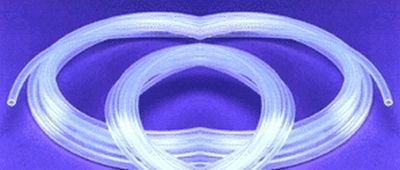
Clear surgical plastic tubing (see pic above), 3/8” - 1/2’ I.D. (Inside Dimension). I suggest a length of 30’, but it really depends on what you’re working on.
Blue or red food coloring to add to the water. Clear tubing + clear water = possible mistakes; make it easy on yourself.
Assemble the Solo Model
First, drill a clean hole near the bottom of the bucket. It should be a bit smaller than the O.D. (Outside Dimension) of your tube.
Squeeze one end of your tubing into the hole. Pull it inside to about the bucket’s center. Apply some silicone caulk to the tube exterior for the last inch or so.
Swab some silicone caulk to the hole/tube circumference on both the inside and outside and let it dry completely. Be generous.
Now bend over about 2” of the other end of the tube and clamp it off.
Squirt the food coloring into the bucket, fill it with tap water, and stir to mix thoroughly.
Put your plastic bucket on a chair or countertop.
Remove the clamp from the far end of your tubing. Allow water to run out through the tube end until there are no bubbles in the tube. Any bubbles at all will make the level inaccurate because of how they displace the water.
Add tap water to the bucket as needed.
How to Use Solo Water Level
Once again, ensure that there are no air bubbles, especially if the bucket has been out of use for a while. Also, be sure that the water is a few inches from the lip of the bucket.
Set your bucket on a countertop or another stable object that is high enough to make working comfortable (not a ladder or Baker scaffold!). The marks that you’ll make from this elevation are simply reference marks. This means you’ll use them to measure up to or down from.
Holding the end of the tube above the level of the bucket, remove the Pony™ clamp. From this point on, the end must stay above the plane of the bucket; lose any water and you’ll have to start over.
Raise the end of the tubing to make your first reference mark so that you have 6” or so of free space between the water and end of the tube.
Work around the room, marking all necessary points. For things like chair rail trim or something else that calls for striking chalk lines, mark all inside and outside corners of the walls. Hold the end of your tubing vertically on the wall and allow the water level to settle out.
You’ll see that the water is a bit concave in the tube. This is to be expected. Just pick the high spot or the low spot and stick with it.
Assemble and Use the Helper Model
Mix water and food coloring and add to the tube so there is about 6” of air on either end. This is easiest done with a helper.
Bend both end over and clamp to prevent leakage.
To use: First be sure there are no air bubbles. Eliminate them by unclamping and holding the ends as high as possible and work bubbles out by beginning in the center and tapping the tubing.
They will flow upward by natural buoyancy so you’ll probably need to secure the ends up high and you and the helper take one side of the center and each work towards your respective ends.
The helper makes a mark anywhere on the wall about eye level and you go to where the first reference mark is to be made.
From here on out, the helper slides the tube up and down the wall, while you hold yours stable, until the water settles out and is on the original mark on the helper’s end. Refer to step #4 in the section above on using the solo model, re: concave water.
Things That will Cause False Readings
These are factors to beware of because they can trip you up. First and foremost, be sure all air bubbles are gone. Secondly, water with different temperatures have different “weights” (more accurately, density) for our purposes.
If you add water to top off your system, it must all be the same temperature for accurate elevations.
Knowing how to make a water level to transfer benchmarks is a key skill for carpenters of all stripes. Working your way around a room with a 4’ level will always introduce errors and a laser can't see around corners.
Did you find this article helpful? Please consider supporting this free site with a small donation! We rely on our info-seeking readers rather than a paywall to keep the lights on and the info flowing.
About the Author:
Kelly R. Smith is an Air Force veteran and was a commercial carpenter for 20 years before returning to night school at the University of Houston where he earned a Bachelor’s Degree in Computer Science. After working at NASA for a few years, he went on to develop software for the transportation, financial, and energy-trading industries. He has been writing, in one capacity or another, since he could hold a pencil. As a freelance writer now, he specializes in producing articles and blog content for a variety of clients. His personal blog is at I Can Fix Up My Home Blog where he muses on many different topics.









 Kelly R. Smith is an Air Force veteran and was a commercial carpenter for 20 years before returning to night school at the University of Houston where he earned a Bachelor’s Degree in Computer Science. After working at NASA for a few years, he went on to develop software for the transportation, financial, and energy-trading industries. He has been writing, in one capacity or another, since he could hold a pencil. As a freelance writer now, he specializes in producing articles and blog content for a variety of clients. His personal blog is at