Ads we feature have been independently selected and reviewed. If you make a purchase using the links included, we may earn a meager commission, which helps support the site. We thank you in advance.
There are many ways to increase energy efficiency and lower power bills. Both of those two concepts go hand in hand and they are more important than ever; radiant barrier foil (developed for NASA) and attic insulation address them both.
The Importance of Conserving Energy Now
We stand on the threshold of great change in energy production. The promise of alternative energy has yet to materialize although it shows promise. Conventional solar panels are not workable enough on a large scale, windmills as presently designed and deployed slaughter birds, but the recent emerging innovations of the new technology are changing that.
The are two problems with fossil fuels. First, on the domestic front, politicians, especially those in the Obama and Biden administrations, until recently have stood in the way of production. Secondly, the petroleum that is produced abroad puts us at the mercy of petro-tyrants. With recent developments such as shale oil and horizontal drilling, the U.S. has been gaining in the global market share, so there exists a glimmer of hope on that front.
All homeowners can do at this point to protect themselves is be proactive with green home building
on new construction, or some sustainable retrofitting on existing homes. The attic is a great place to start; the top-down approach and all that, right?. After all, the roof is what takes the brunt of the summer sun and the frigid snow build-up in the winter.
Radiant Barrier Foil or Paint?
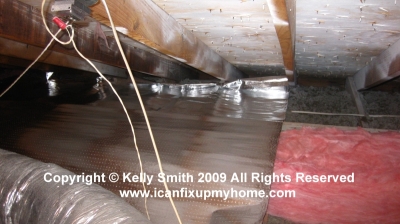
This is the question. I’ve done both on my home (see the photo above). Foil proponents say that paint is not a “real” thermal shield, which sounds a bit like whining. The problem with paint is two-fold: the effectiveness varies wildly by manufacturer and some installers (sprayers) thin it out too much to boost their own profit profit at the homeowner’s expense. And who's to know?
With foil, on the other hand, you know what you’re getting; seeing is believing. The effectiveness is rated by a property called the emissivity (also called the emittance). The lower the number, the better.
There are many manufacturers. I used the Energy Q brand. It’s the one NASA wraps their space-bound gadgets with and my research showed me that it is one of the most efficient brands on the market. In reality, most brands are close enough in quality and they are all going to keep more money in your pocket.
Part of the economic stimulus package increases the tax credit for insulating material. Foil falls in this category. Note, however, that the credit only applies to the material, not labor installation costs. This makes it a sensible DIY project. In this article I detail the steps you can take to install it. This is a great DIY project to do in the cool months following New Years, but any time is good depending on your latitude.
Methods for Installing Radiant Barrier Foil
There are four common methods of installation:
Stapling it directly to the rafters supporting the roof sheathing.
It is available incorporated into roof sheathing. This is a good option for new construction.
Stapling it in the space between the rafters.
Laying it on the attic floor.
This is the most effective way to keep the heat in the home in the winter months. It’s also the best way to keep cool in summer by virtually eliminating thermal transfer. Jim Dutton of the Texas Home Improvement show (AM 740 in Houston) explains it best. And I paraphrase:
The attic is going to get hot anyway. The important thing is the keeping it out of the living area.
In my case, I followed the fourth choice. My attic has little headroom to begin with, and the wood framing for the vaulted ceiling makes maneuvering even more difficult. If the attic is being used as a living space, choice number one, two, or three should be followed.
Tool List for Installation
These are the basic tools:
Utility knife.
Two tape measures, one to leave stretched out on the driveway for measuring, the other to take measurements in the attic.
You can use one, but two is more convenient. It’s a real head-slapper for the installer to get ready to take more measurements in the attic just to discover he’s left it downstairs on the driveway. Believe it. Been there, done that, I’m mortified to admit.
One or more rolls of metallic duct tape, not the cheap kind which will not hold up in a hot attic.
A roll of masking tape.
A can of bright-colored spray paint to mark places where it is safe to walk.
1” X 6” board, 5’ or 6’ long.
Knee pads.
A long stick with a nail on the end for pushing the foil into tight corners. Due to the way my attic space is, I used a litter-gathering stick (with that pointy thing on the end) and taped it to the end of a telescoping paint roller handle. Innovation is a worthwhile habit to develop. It works for woodworking jigs, right?
Cutting and Rolling Out the Foil
The tricks here are planning and procedure. The game plan should be to work from the small corners and end up at the attic entrance point. In other words,don't paint yourself in a corner, so to speak.
Measure and cut only as many pieces as is reasonable. Make it easy, the pieces don’t all have to be aligned in the same direction. The edges just need to be overlapped by 3” or 4”.
Cut the radiant barrier foil on the driveway on a board to keep your knife from dulling on the concrete.
Stretch out and lock the tape measure blade along the length of the driveway.
Set the 1” X 6” board perpendicular to the tape measure at the number appropriate for the length of the sheet.
Place the roll at the end of the tape measure blade.
Unroll the foil up to and over the board. If the sun is bright, wearing a pair of polarized sunglasses wouldn’t be a bad idea; the reflection off the foil can be intense. Which after all, is the whole point.
Cut the foil on the board using your utility knife. Scissors work as well, but I've found a knife is easier to wrangle.
Starting at the end away from the roll, carefully roll up the sheet and secure it with a bit of masking tape. Don’t roll it too tight or too loose. The center of the roll should be about 2 1/2” wide, more or less; let experience be your guide.
Unroll the sheets in the attic and put them in place. Use the nail-stick for both unrolling and fine-tuning the placement.
Don’t cover up soffit vents; this will impede air flow through your ridge vents or whirly-bird, whichever you have.
It may be necessary to cut the foil to accommodate framing members. Cut a slit in the sheet and a double “T” where the framing passes through it. Seal the slit with metallic duct tape. Take your time; you only want to do this once.
Take numerous water-drinking breaks.
Spraying the Radiant Barrier Paint
The paint can be purchased pre-mixed or as a powder to be mixed with white latex paint. If the powder is used, it’s important to wear a respirator when mixing! The powder is very light, prone to floating around in the air, and you don't want to breath it in.
A compressor-driven or an airless paint spray rig may be used. Just be sure to use the proper tip. The active ingredient is generally microscopic porcelain beads and aluminum flakes and they need room to get out.
Wear a respirator and goggles when spraying the underside of the roof sheathing.
Other Energy-Conserving Tasks
There are a few other things to do as the installation progresses. Check the ductwork from the plenum to the registers. Replace or repair as needed.
It only makes sense to add insulation while installing the foil. Insulation is also eligible
for the energy tax credit. But once again, just for the price of the material. Save all receipts for when the time comes to file federal tax returns.
I certainly hope this radiant barrier installation article has inspired you to tackle the project and start saving money! If so, I would appreciate you sharing this page with your friends. Thanks for visiting!
Did you find this article helpful? Millions of readers rely on information on this site and our blog to stay informed and find meaningful solutions. Please chip in as little as $3 to keep this site free for all.