If your home has a basement or is built off the ground with post-and-pier supports, you probably have some plywood or OSB subflooring.
Moisture Leads to Plywood Subfloor Repairs
The usual culprit causing rotted plywood subflooring is water damage. Given that fact, you would expect it in your kitchen or bathroom. Do you find yourself in this unlucky situation? How about repairing your plywood or OSB subflooring yourself?
Tool and Material List
Pry bar (for old tack strips if you have them)
Chalk line
Hammer
Tape measure
Utility knife
Circular saw
Chisel
Screws and/or nails
Plywood or OSB as needed
Wood putty
Should You Use Plywood or OSB?
The choice really boils down to personal preference; each material has its pros and cons. Both plywood and oriented strand board (OSB) are about equal in strength and durability. Building codes generally recognize both plywood and OSB to be alike in their properties and use the phrase "wood structural panel" to describe them. But, plywood subfloors are stiffer than OSB by about 10%.
Keep in mind that if you live in one of those currently-popular tiny houses, the building codes have been somewhat amended since they are not full-size structures. Before beginning any work on any size structure, check your local codes and pull building permits as applicable prior to beginning any work.
Depending on the scope of your flooring project, OSB is cheaper than plywood by about $3 to $5 per panel. OSB is known to be less water-resistant; it swells in thickness when exposed to moisture. OSB has has more decay resistance than plywood.
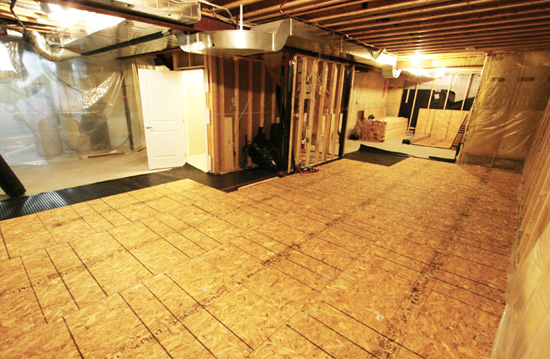
OSB Subflooring with a Vapor Barrier.
Many contractors find OSB easier to work with on larger projects because usually the sheets have a grid pattern inked on them, almost eliminating the need for carrying around a T-square. But on simple repairs, who cares? Given all these factors, it really boils down to budget and environment.
Remove the Current Finished Floor
In most cases the whole subfloor doesn’t need repair, only limited areas. To determine this you will have to remove your current finish floor, whether it’s sheet vinyl, carpet, or something else. It’s a great time for remodeling anyhow.
If carpet is what you have and it still has some life left, you can undo it from the tack strip and roll it up to reuse. If not, just get rid of it and the padding.
Important Step: Get Your Homeowner’s Insurance Agent Involved
Prior to doing anything further, give your
homeowner’s insurance agent a call to review your situation and file an insurance claim. If you’re covered and you do the repair yourself, you’ll save all the labor costs that will they’ll pay you for.
Take Note of your Damage and Prep the Area
Now take a look at your plywood subfloor. Make a note of which areas need repair. Do a visual inspection and poke it with something sharp to test for mushy spots.Plywood is an engineered wood product that holds up well, but too much moisture will break it down.
Everytime you find a spot, mark it with spray paint. When you've found all the bad spots that need repair, strike chalk lines so you’ll know where to cut.
The Good Old 3-4-5 Rule
Keep two things in mind: the spots marked off must be square. Use the 3-4-5 rule to ensure this. Secondly, any cut you make parallel to a floor joist must be down the nearest joist’s center line. Strike your chalk line centered on the existing nail or screw heads.
Cut Out the Damaged Subfloor
Use an electrical circular saw to remove the damaged spots. Prior to cutting, look at the underside of your subfloor if you can, from the basement, to prevent cutting through electrical wiring or plumbing.
Set your blade cutting depth just one 1/8 inch deeper than the damaged plywood subfloor. When you close in on a wall you’ll find that the bottom plate of your circular saw will prevent you from reaching the wall. It’s time to use your hammer and chisel.
As an alternative to hammer and chisel, an effective power tool is one of the new oscillating tools like the Rockwell SoniCrafter, Dremel Multi-Max, or Fein MultiMaster.
Replace the Damaged Plywood
Now that the bad plywood is gone you can install the new. There are two things to consider: the thickness of the existing plywood and the amount of new plywood you’ll need to buy. Plywood is sold in 4’ X 8’ sheets so you’ll need to buy a little extra to account for scrap.
When you get the new plywood home the rest is easy: taking measurements, cutting the sheets, and installing them. Drywall screws with coarse threads are good for this project.But before you lay any plywood on the floor joists, lay down a bead of construction adhesive on the joists. Use a green building product like Bostik Home Heavy Duty Construction Adhesive.
It’s developed especially for subfloors, stair treads, and decks. Back in the day, the subfloor was simply nailed down. But the nails would soon work loose and cause squeeks. When you’re done, putty any large gaps.
In years past, plywood subfloors were nailed down. The problem is that after a few years, the nails would work loose. What a pain to have to pull carpet or other finish floor to stop the squeeks! The thing to do now is to apply glue and to use screws rather than nails.
Now that you've finished your plywood subfloor repair it’s time to install the new finish floor and install baseboards... but that’s another project!
Did you find this article helpful? Thanks for supporting this free site with a small donation!
About the Author:
Kelly R. Smith was a commercial carpenter for 20 years before returning to night school at the University of Houston where he earned a Bachelor’s Degree in Computer Science. After working at NASA for a few years, he went on to develop software for the transportation and financial and energy trading industries. He has been writing, in one capacity or another, since he could hold a pencil. As a freelance writer now, he specializes in producing articles and blog content for a variety of clients. His personal blog is at I Can Fix Up My Home Blog where he muses on many different topics.















 Kelly R. Smith was a commercial carpenter for 20 years before returning to night school at the University of Houston where he earned a Bachelor’s Degree in Computer Science. After working at NASA for a few years, he went on to develop software for the transportation and financial and energy trading industries. He has been writing, in one capacity or another, since he could hold a pencil. As a freelance writer now, he specializes in producing articles and blog content for a variety of clients. His personal blog is at