Ads we feature have been independently selected and reviewed. If you make a purchase using the links included, we may earn a commission, which helps support the site. Thank you for your support.
Providing electrical circuits to bathrooms are similar to kitchens but unlike bedrooms. Bathrooms by nature are damp so wiring must be GFCI-protected and exhaust fans must be provided.
Bathrooms are unique in the home when it comes to electrical service. By nature, bathrooms are damp environments and water and electricity make poor bedfellows. We've all seen those movies involving bathtubs and electrical appliances. The previous article examined wiring a kitchen; the next one discusses powering a laundry room or workshop. This one discusses how to wire a bathroom.
Considerations for Bath Electrical Circuits
Like all home electrical work, it’s important to consult with the local building code before beginning to wire a home bathroom. Local building codes vary by area but some things are common. It's safe to say that they all require using Romex or nonmetallic (NM) cable. So, bottom line, always consult your local electrical building code and keep in mind that there is some work that requires permits and a licensed electrician.
Also, don't rely on what you knew to be true about the code during your last project; they change all the time. Local codes may vary appreciably, but there are recommended national standards For example, consider the 2020 national electrical code changes.
If your code does indeed require a licensed electrical contractor for the scope of your project, you can’t go wrong checking friend's references and BBB status before you accept any bid.
For instance, your code might make the requirement that the electrical receptacles be on one circuit and the exhaust fan and the light fixtures be on another. As with other rooms, install the light switch so that it is approximately chest high close to the door.
Although in some areas it’s permitted to allow bathroom lights and receptacles to share a circuit with other rooms, keep in mind that it’s not always a good idea. Also, most building codes require that all bathroom wiring be GFCI-protected. I've never seen one that doesn't, but still, it is common sense.
If hot water is provided by a tankless water heater, the building code may require it to be on its own circuit.
Installing a Bathroom Vent Fan
It’s always a good idea to install a bathroom vent fan. Although there may still be some local building codes don’t require one, it’s always a good idea to get rid of the moisture and vent it to the exterior of the home. Too much moisture promotes mold and mildew, it’s uncomfortable in the winter months, and bathrooms can have their own peculiar odors.
Installing and wiring up a bathroom vent fan is similar to installing a ceiling fan, except for the weight factor.
In many cases the fan is wired to the same on/off switch as the light but not always; if you are doing the installation it is a matter of preference (as a caveat, ALWAYS consult with your spouse). If the local building code doesn’t address it, then it is up to the residential architect or homeowner. Every now and then, the vent fan and the light are incorporated into one unit.
Wiring Bathroom Lights
Bathrooms should be well lit, so it’s important to plan for at least two sources of light; general lighting which may be a recessed canister fixture or a surface mounted fixture, and functional lighting at the bathroom sink/mirror, usually called a bath vanity for obvious reasons.
The general light may be provided by a low-voltage halogen bulb or a LED spotlight. Either of these will provide energy savings.
The functional lighting is usually a strip lighting fixture directly over the sink/mirror but some homeowners prefer to place a sconce on either side of the mirror. In the end, it’s simply a matter of decorating choice.
Some baths include a recessed can light with a waterproof lens cover in the shower area, but in most cases this is not needed, it is simply aesthetic.
Wiring Bathroom Electrical Receptacles
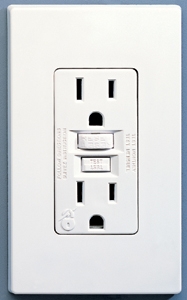
Plan on installing at least one receptacle on the wall next to the sink. It must be a 20-amp GFCI receptacle and should be positioned so that the cord of a hair dryer or similar appliance doesn’t drape over the sink. Again, electricity, water, and human mortality aren’t very good friends! This is not rocket science, but in the scope of things, it is easy to forget to consider it.
In most cases, bathrooms are not big enough to require any more electrical receptacles. In no case should one be installed below the level of the sink. Remember that the bathroom should be an inviting and well-lit room. Designing the bathroom and planning and wiring a bathroom with this in mind will result in success!
Did you find this article helpful? Millions of readers rely on information on this site and our blog to stay informed and find meaningful solutions. Please chip in as little as $3 to keep this site free for all.
About the Author:
Kelly R. Smith was a commercial carpenter for 20 years before returning to night school at the University of Houston where he earned a Bachelor’s Degree in Computer Science. After working at NASA for a few years, he went on to develop software for the transportation and financial and energy trading industries. He has been writing, in one capacity or another, since he could hold a pencil. As a freelance writer now, he specializes in producing articles and blog content for a variety of clients. His personal blog is at Considered Opinions Blog where he muses on many different topics.














 Kelly R. Smith was a commercial carpenter for 20 years before returning to night school at the University of Houston where he earned a Bachelor’s Degree in Computer Science. After working at NASA for a few years, he went on to develop software for the transportation and financial and energy trading industries. He has been writing, in one capacity or another, since he could hold a pencil. As a freelance writer now, he specializes in producing articles and blog content for a variety of clients. His personal blog is at