Make a Knockdown Texture Tool
A Unique Alternative to Crow's Foot, Rolled, Spray Texture
© 2008 by Kelly R. Smith; all rights reserved; content may not be copied, rewritten, or republished without author’s written permission.
This article was updated on 02/17/21.
Ads we feature have been independently selected and reviewed. If you make a purchase using the links included, we may earn a meager commission, which helps support the site. We thank you in advance.
Residential wood framing provides structure, but drywall texture gives the wall its character. If it is time to refresh your walls you might consider an new texture There are many drywall texture techniques. You can make a statement with this unique knockdown tool.
Drywall texture patterns add character to both ceilings and walls. Additionally, they conceal a
multitude of irregularities in the framing, sub-par drywall taping and floating (or drywall finishing),
and patched drywall seams.
There are quite a few application tools and applying a consistent pattern is an art form unto
itself (Except in the case of using a drywall texture spray out of a hopper; anyone can squirt a
wall).
What is a Knockdown Texture?
The knockdown technique got its name from the application method. The craftsman uses a patterned tool
to apply the texture in the first step.
When he pulls it off the sheetrock it leaves pointed peaks.
In the second step a broad drywall floating knife is dragged across it to “knock down” the
raised peaks.
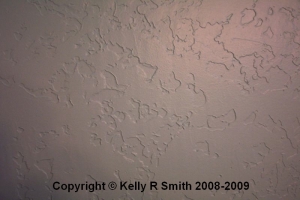
The tool conveys the particular pattern. The pressure applied to the knife determines the depth.
Another very common technique is applied with a stomp brush or crow’s foot texture tool. Too
involved? It’s also a simple matter to apply a
paint roller texture.
Tool List
- Sharpie permanent marker
- Electric drill with bits
- Dremel rotary tool with bits
Knockdown Texture Tool Material List
- Wide kitchen cabinet drawer handle; approximately 1 1/2” wider than your hand.
- 1“ X 1“ piece of 1/4” or thicker Plexiglas
- A piece of of 1/2” wood dowel; 3” long
Design and Cut Out the Drywall Texture Tool
A plastic drywall compound bucket is used during the application. Because the tool is going to be
dipped into the bucket, the Plexiglas should be approximately round-shaped.
It should also be of a
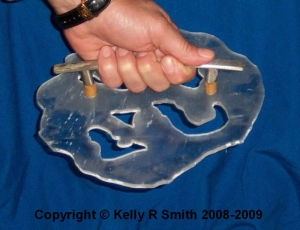
size that it can fit easily into the bottom of the bucket. (Have a look at the photo at the top of this article.)
- Note: all drilling and cutting must be done very slowly and
carefully to avoid cracking and splitting the Plexiglas. Been there; done that!
- Use your Sharpie to sketch the basic round shape.
- Draw an assortment of curvy designs around the inside of the round shape (see photo). This
provides a bit of an irregular outside edge which is what you want for a somewhat random pattern.
- Find the center. Using that point measure out equal distances to locate where your two handle
bolts will be attached. You want it to be balanced because the drywall mud can get a bit heavy on larger projects. No sense fighting yourself and gravity all day.
- Drill out these bolt holes (the drill bit size depends on the supplied bolts).
- With the Sharpie, freehand random shapes on the interior of the Plexiglas to cut out. Don’t
put in too many or get too close to the handle holes; it will compromise the texturing tool’s
strength.
- Drill pilot holes for each internal shape to insert the Dremel cutting
accessory bit.
- Carefully and slowly cut out the shapes.
- Cut out the outside edge.
Final Tool Assembly
- Insert the handle bolts through the holes.
- Measure and cut your dowel pieces to take up space difference. You want the bolt heads to
flush up on the Plexiglas tool surface while allowing the handle to be approximately 1 1/2” away
from the tool’s surface.
- Drill holes, just a hair larger than the bolt’s diameter, through the center of your
dowels. A
benchtop drill press
is what I used to make the holes perfectly down the center. If that’s not available, hold the dowel
in a bench vice and drill carefully to keep the holes centered.
- Assemble the kitchen cabinet handle onto the tool.
That’s about it. This knockdown texture tool has made me a lot of money over the years. If you would rather just hire a pro rather than try to match an existing texture, be sure to ask for references, check for insurance, and BBB standing.

If you’ve got some creative drywall texturing techniques (I know you’re out there), please share them with our readers in the comment section below.











 Kelly R. Smith was a commercial carpenter for 20 years before returning to night school at the University of Houston where he earned a Bachelor’s Degree in Computer Science. After working at NASA for a few years, he went on to develop software for the transportation and financial and energy trading industries. He has been writing, in one capacity or another, since he could hold a pencil. As a freelance writer now, he specializes in producing articles and blog content for a variety of clients. His personal blog is at