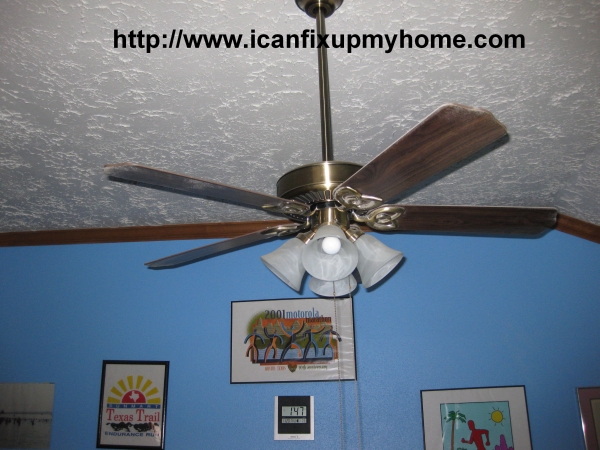
A down-rod ceiling fan hung from a cathedral ceiling
This article was updated on 02/07/20. Happy National Periodic Table Day!
Learn how to install contemporary ceiling fans in the home. An easy DIY project, ceiling fans will lower heating and cooling bills. Manufacturers include Hunter, and Hampton Bay.
Lower Utility Bills and Add (Indoor) Curb Appeal
Contemporary ceiling fans help homeowners conserve energy and save on heating and cooling bills by moving air efficiently in the home.
Ceiling fans also add appeal and style by dressing up the living room or bedroom. And this is a DIY project that any homeowner can take on. This article will show the weekend handyman how to install a ceiling fan.
Choosing a ceiling fan is the hardest part of the process. Things to consider are size, style, how much money to spend, and whether there’s really a need for another remote control to hide itself in the couch cushions!
Choose a fan that is reversible. It should blow down in the summer and up in the winter. Why up? Because warm air rises and aiming the fan blades at it cause the warmer air not to accumulate, but to roll down the walls, and rise again through the living area.
Tools Required for Ceiling Fan Installation
Stepladder and a helper to steady it. Go ahead, throw the kid a couple of bucks and teach a bit of DIY.
Screwdrivers (flat blade and Phillips #2 tip are the most commonly called for)
Wire cutters or side cutting pliers (Klein’s electrician’s pliers are highly recommended)
Setting Up the Electrical Connections
Ceiling fans are heavy and they tend to vibrate so it’s important to use a fan-rated electrical junction
box. Cut out the drywall and insert the box into the opening. Secure it to the wood joists on either side
using a box brace. This is easiest done from the attic.
Wire the box after being certain that the appropriate circuit breaker is turned off just like when
replacing an electrical light switch. Of course this step isn’t necessary if an old fan is being replaced.
Down Rod Ceiling Fan VS Flush Mount Ceiling Fan
There are two distinct ways to hang a ceiling fan. If the room has a high vaulted ceiling, the down rod fan mount is appropriate, especially if the fan is to be mounted on a sloping ceiling. Down rods are available in various lengths with a finish that matches the fan.
This is a good argument for buying a well known brand of fan such as a Hunter, Hampton Bay, Casablanca, Emerson, or Harbor Breeze ceiling fan.
How low should the fan be hung? At least two feet from the top of the head of the tallest family member. (Remember to pick up longer pull chains and down rod extension.)
For a standard eight foot ceiling, a flush mount is the way to go. This will usually involve using the (supplied) very short down rod with the ball. Most contemporary ceiling fans use the ball and socket approach.
Wire and Hang the Ceiling Fan
Connect the down rod to the fan. The electrical wire leads from the fan should be fed through the rod. Slide the canopy and any trim down the down rod and hang the ball in the socket. This will make it easy to connect the wires.
Connect the house electrical supply wires to the fan wires and use appropriately-sized wire nuts to secure the connection. These should be supplied by any quality name brand ceiling fan, such as one of those listed above. The instruction manual will specify wire details for that particular model.
Secure the canopy and trim at ceiling level, being careful not to pinch any wires. Now attach the fan blades. Generally, these snap into place but details vary by manufacturer. Install the lights if so equipped.
Carefully examine the bottom of the fan. Sometimes the ceiling fan manufacturer puts rubber wedges in the bottom outside edge to keep it from spinning during installation. The installation manual usually omits this little fact.
This is a big frustration to the first time installer who is left scratching his or her head. “The lights work but the fan doesn't? What gives?”
Finally, turn the circuit breaker on and enjoy the tropical breeze. Hopefully this article on how to install a ceiling fan has helped you with your installation project. Details from different models may vary but the basics are the same.
Did you find this article helpful? Please consider supporting this free site with a small donation! We rely on our info-seeking readers rather than a paywall to keep the lights on and the info flowing.
Kelly R. Smith is an Air Force veteran and was a commercial carpenter for 20 years before returning to night school at the University of Houston where he earned a Bachelor’s Degree in Computer Science. After working at NASA for a few years, he went on to develop software for the transportation, financial, and energy-trading industries. He has been writing, in one capacity or another, since he could hold a pencil. As a freelance writer now, he specializes in producing articles and blog content for a variety of clients. His personal blog is at I Can Fix Up My Home Blog where he muses on many different topics.












 Kelly R. Smith is an Air Force veteran and was a commercial carpenter for 20 years before returning to night school at the University of Houston where he earned a Bachelor’s Degree in Computer Science. After working at NASA for a few years, he went on to develop software for the transportation, financial, and energy-trading industries. He has been writing, in one capacity or another, since he could hold a pencil. As a freelance writer now, he specializes in producing articles and blog content for a variety of clients. His personal blog is at