Ground fault circuit interrupter (GFCI) electrical receptacles are mandated by standard electrical building codes during residential wiring installation by licensed electrical contractors.
What exactly is this electrical ground fault protection and why do you need it? Consider some basic facts of nature that you might be acquainted with. You know that water always seeks its own level in a water level tool.
In such a manner electricity always looks for the most effective route to go to ground. And that is why commercial office buildings use grounded lightning rods to keep inhabitants safe and contents safe. When the inevitable lightning strikes, the metal rods on the upper levels of the structure route the electrical charge to the ground, bypassing the contents and people in the building.
Well, that’s just the way it is with your home’s electrical wiring. Imagine when a bare electrical wire housed in a metallic kitchen appliance finds itself in contact with the metal housing.
What happens? Now the metal outer part of your kitchen appliance becomes electrically energized. Suppose you, as the cook, grab the appliance with your left hand and your sink’s faucet, properly grounded, with your right hand.
The deadly result is that a potentially lethal current is sure to flow through your body. You becomes the electron flow’s shortest path to ground. To avoid this potentially deadly situation, GFCI (Ground Fault Circuit Interrupter) receptacles are installed it kitchens and bathrooms and some other areas by code.
How Does the Circuit Interrupter Work?
The GFCI receptacle continually monitors the circuit that it’s installed on. When any situation that threatens an electrocution emergency occurs, the GFCI immediately breaks the connection, like a circuit breaker. The person involved will most likely still experience an electrical shock. Uncomfortable but not life-threatening. Which outcome would you rather have?
Where in Your Home does the Building Code Require GFCI Receptacles?
The electrical building code requires these in certain circumstances. The common denominator is any environment where water and moisture are likely. This means outdoor lighting fixtures, bathrooms, unfinished basements, kitchens, garages, and crawl spaces.
The code mandates are specified in the National Electrical Code. Of course all residences aren’t completely up to code because of when the home was built or because rooms were added on. For instance, outdoor receptacles were added to the NEC in 1973 and unfinished basements were included in 1990. Oddly, the requirement for installing GFCI receptacles when wiring kitchens wasn’t added until 1987.
Any homes that are not up to code on GFCI receptacles in bathrooms and kitchens should consider installing them. They’re cheap, but human life is priceless. As they say, "If you don't do it for yourself, do it for your family." Before beginning a wiring project, it’s important to understand home wiring fundamentals.
How Do You Test Ground Fault Interrupters?
Like residential smoke detectors, toxic radon detectors, and fire extinguishers, ground fault interrupters need to be tested for reliable operation on a monthly basis. The US government tells us to test them immediately after installing them, and then every month regularly. Here are the steps:
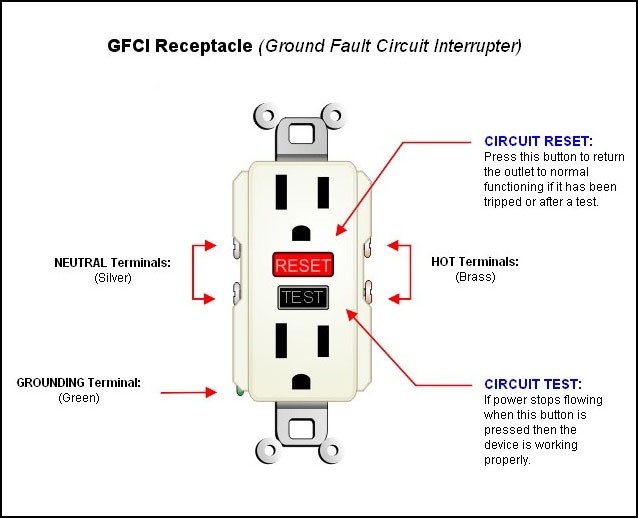
You’ll notice 2 buttons on the unit; Reset (usually red), and Test (usually blue). Begin by plugging a light into it. It should light up.
Press the Test button.
The light should go out, and the Reset button should pop out.
If Reset pops but the light stays on, the receptacle is probably wired incorrectly. Rewire it.
If Reset doesn’t pop out, this indicates that the GFCI is faulty; toss it out and replace it.
If everything tested properly in step 3, everything’s fine. Press Reset and repeat next month!
A proper understanding of why using GFCI receptacles in the bath and kitchen is so important is the first step in keeping you and your family safe from electrocution. The second is ensuring that they are installed. The third step is to test them every month. As a mental reminder, do it on the first of the month, when a recurring bill is due, or any other date that is convenient.
Did you find this article helpful? Millions of readers rely on information on this site and our blog to stay informed and find meaningful solutions. Please chip in as little as $3 to keep this site free for all.
About the Author:
Kelly R. Smith was a commercial carpenter for 20 years before returning to night school at the University of Houston where he earned a Bachelor’s Degree in Computer Science. After working at NASA for a few years, he went on to develop software for the transportation and financial and energy trading industries. He has been writing, in one capacity or another, since he could hold a pencil. As a freelance writer now, he specializes in producing articles and blog content for a variety of clients. His personal blog is at I Can Fix Up My Home Blog where he muses on many different topics.













 Kelly R. Smith was a commercial carpenter for 20 years before returning to night school at the University of Houston where he earned a Bachelor’s Degree in Computer Science. After working at NASA for a few years, he went on to develop software for the transportation and financial and energy trading industries. He has been writing, in one capacity or another, since he could hold a pencil. As a freelance writer now, he specializes in producing articles and blog content for a variety of clients. His personal blog is at